

WASHINGTON — September ended with a warning beneath the surface of the U.S. stock market: the major indexes did not tell the whole story.
The S&P 500 slipped about 0.3% for the month, while the Nasdaq Composite gained roughly 1.9%. The Dow Jones Industrial Average fell about 4.3%, and the Russell 2000 dropped 5.3%. The sharp contrast shows how much of the market’s strength remained concentrated in large technology and AI-related companies.
That backdrop makes October particularly important. Investors are entering the fourth quarter with a weaker labor market, inflation that remains above the Federal Reserve’s target, elevated Treasury yields and sharply lower expectations for another rate increase at the Fed’s October meeting.
The market is no longer pricing the same urgency for another rate hike that it did only weeks ago. The September employment report added to that shift after the U.S. economy created just 29,000 jobs and the unemployment rate rose to 4.2%. Revisions also erased about 60,000 jobs from the previous two months.
That does not mean the Federal Reserve has defeated inflation. It means the central bank now has a more complicated policy problem.
October Starts With a Different Market Setup
September has historically been the weakest month for U.S. stocks. October, however, has a very different reputation.
The month carries a history of severe market crashes, which explains the familiar term “October phobia.” But history also shows that October can deliver strong gains, particularly when viewed as the opening month of the strongest quarter of the year.
Seasonality alone is not a reason to buy stocks. It simply removes one historical headwind from the equation.
The more important change comes from monetary policy.
Market expectations for an October rate hike have fallen dramatically as economic data showed a combination of cooling employment and inflation that remains elevated but is not accelerating fast enough to force an immediate policy response.
The latest labor figures are particularly important. Job openings have remained relatively high, while weekly unemployment claims have stayed near historically low levels. At the same time, hiring has slowed considerably.
That creates an unusual environment for the Fed. The economy has not collapsed, but the labor market no longer looks strong enough to justify aggressive additional tightening without stronger evidence that inflation requires it.
Inflation Has Not Disappeared
The inflation picture remains the biggest reason investors should resist excessive optimism.
Headline personal consumption expenditures inflation remained elevated at 3.4% year over year, while core PCE stood at 3.0%. Both remain above the Fed’s 2% target.
Manufacturing data delivered another warning.
The ISM manufacturing index came in at 54.5, comfortably above the 50 threshold that separates expansion from contraction. But the prices-paid component jumped to 77.9, its highest level since May. Higher energy costs, tariffs and geopolitical disruptions contributed to the increase.
In other words, economic growth remains intact while some inflation pressures are building again.
That combination makes the Fed’s next moves difficult to predict.
For investors, however, the immediate takeaway is clearer: a cooling labor market reduces the pressure for an immediate October hike, while persistent inflation prevents the Fed from declaring victory.
The next major clues will come from services inflation, consumer sentiment and upcoming inflation reports. Services matter especially because they account for the majority of U.S. economic activity.
Five Stocks With Different Catalysts
Against that backdrop, investors do not necessarily need to buy the market indiscriminately.
A better strategy may be to focus on companies where the investment thesis depends on long-term business growth, improving valuations, industry trends or a potential turnaround.
Five names stand out for October: Broadcom, MercadoLibre, UnitedHealth Group, Uber and Lumentum.
Each represents a different opportunity.
1. Broadcom: AI Infrastructure Still Has Room to Run
Broadcom remains one of the clearest ways to invest in the infrastructure behind the artificial intelligence boom.
The company generated $29.6 billion in fiscal third-quarter revenue, up 86% from a year earlier. Free cash flow reached $13.7 billion, while management guided fourth-quarter revenue to approximately $34.8 billion. AI semiconductor revenue alone reached $16.7 billion in the latest quarter, up 221% year over year.
The important point is that Broadcom is not simply another semiconductor company benefiting from AI enthusiasm.
Its exposure stretches across networking and custom AI accelerators, two areas that become increasingly important as AI data centers grow larger and more complex.
The AI investment cycle requires enormous amounts of computing power, memory, networking equipment and specialized silicon. Broadcom sits directly inside that infrastructure chain.
That makes the stock attractive even after a powerful run.
The biggest risk is valuation. Expectations for AI spending have become extremely high, meaning any slowdown in hyperscaler capital expenditures could create significant volatility.
Still, as long as demand for AI infrastructure continues to expand, Broadcom remains one of the strongest large-cap candidates in the sector.
2. MercadoLibre: A Pullback in a High-Growth Business
MercadoLibre offers a completely different opportunity.
The Latin American e-commerce and fintech giant continues to grow at a pace that would be difficult for most mature technology companies to match.
In the second quarter, revenue and financial income reached $10.2 billion, up 50% year over year. It marked the company’s 30th consecutive quarter with growth above 30%.
Unique active buyers increased 26%, Mercado Pago’s monthly active users climbed 30%, assets under management rose 68% and total payment volume surpassed $100 billion for the first time. Advertising revenue also jumped 73% in U.S. dollar terms.
Those numbers matter because MercadoLibre is no longer simply an online marketplace.
The company has built an ecosystem spanning e-commerce, payments, credit, advertising and logistics.
That diversification gives MercadoLibre multiple engines for future growth.
The biggest question is valuation. A fast-growing company can justify a premium multiple, but investors still need to determine whether future earnings growth can support the stock price.
After the stock’s pullback, however, the risk-reward equation has become more interesting.
Rather than trying to predict the exact bottom, investors could view weakness as an opportunity to build exposure gradually to a business with several long-term growth drivers.
3. UnitedHealth Group: A Turnaround That Needs Proof
UnitedHealth Group represents the contrarian side of the list.
The healthcare giant has faced a difficult stretch involving elevated healthcare utilization, Medicare Advantage pressure, regulatory scrutiny and broader concerns surrounding the company’s operations.
That has pushed the stock far below its previous highs.
But depressed sentiment can create opportunity if the underlying earnings power begins to stabilize.
UnitedHealth generated $112 billion in second-quarter revenue and $8 billion in operating earnings. Adjusted earnings reached $6.38 per share, while management raised its full-year adjusted earnings outlook to between $19.50 and $20.00 per share.
That does not eliminate the company’s risks.
Government reimbursement policies, Medicare Advantage economics, healthcare utilization and regulatory pressure remain critical variables.
The next major test arrives on October 13, when UnitedHealth is scheduled to report third-quarter results.
That report could determine whether the company’s recovery story has genuine momentum or whether investors have simply become too optimistic.
For October, UnitedHealth therefore represents a valuation-and-turnaround trade rather than a straightforward growth investment.
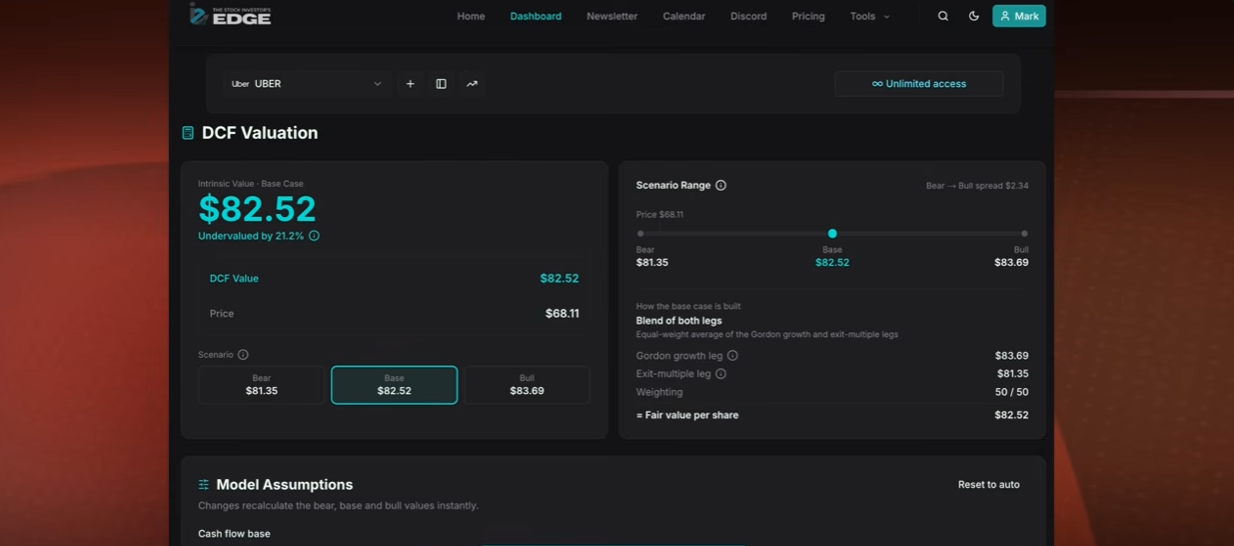
4. Uber: Autonomous Vehicles Could Become an Opportunity
Uber remains one of the more misunderstood stories in the autonomous-driving race.
The conventional argument is simple: if robotaxis become widespread, autonomous vehicles will eliminate the need for Uber drivers and eventually undermine the company’s business model.
But that assumes Uber needs to own the technology that drives the vehicles.
It does not.
Uber’s most important asset may be the marketplace connecting riders with transportation.
The company is already positioning itself to participate directly in the robotaxi ecosystem. Its partnership with Lucid and Nuro includes plans for at least 35,000 Lucid vehicles equipped with Nuro’s autonomous-driving technology. Testing has already begun, with an initial commercial rollout planned for the San Francisco Bay Area.
Uber has also partnered with Nvidia as it prepares for a much larger autonomous fleet. The companies have discussed a target of 100,000 autonomous vehicles beginning to scale globally from 2027.
That changes the investment thesis.
Instead of viewing robotaxis exclusively as a threat, investors can view them as another supply source that could eventually operate through Uber’s marketplace.
The company could potentially benefit from autonomous fleets without having to develop every piece of self-driving technology itself.
That does not make Uber risk-free. Competition will intensify, autonomous-driving regulation remains uncertain, and the economics of robotaxi operations have yet to fully prove themselves at scale.
But the market may be underestimating the possibility that autonomous vehicles strengthen rather than destroy Uber’s platform.
5. Lumentum: The Highest-Risk AI Infrastructure Bet
Lumentum is the most speculative name on the list.
The company operates in optical and photonic technologies that help move enormous amounts of data through modern communications and AI infrastructure.
As AI clusters grow larger, moving data between processors becomes just as important as increasing computing power.
That creates a potentially significant opportunity for optical connectivity.
Lumentum reported fiscal fourth-quarter revenue of $1.01 billion and guided fiscal first-quarter 2027 revenue to between $1.225 billion and $1.275 billion. Management also projected a non-GAAP operating margin between 39.5% and 40.5% and adjusted diluted earnings of $4.05 to $4.35 per share.
The company’s exposure to 1.6-terabit optical modules and optical circuit switching gives investors another way to participate in the expansion of AI data centers.
But this is also where investors need the most discipline.
Lumentum’s stock has already experienced an extraordinary rally, which means expectations are much higher than they were a year ago.
A rapidly growing business can continue rising after a huge rally, but that does not make the stock immune to sharp corrections.
Lumentum should therefore be viewed as a higher-risk, higher-potential-reward position rather than a core holding.
The thesis is straightforward: as AI clusters become larger, faster and more interconnected, optical connectivity could become another critical bottleneck in the AI infrastructure chain.
The Bigger Investment Question for October
The most important lesson from September is not that investors should automatically buy stocks in October.
It is that market indexes can hide significant weakness underneath the surface.
The S&P 500’s relatively modest monthly decline masked much deeper losses across smaller companies and many individual stocks. The Nasdaq’s gain, meanwhile, reflected the continuing strength of large technology and AI-related companies.
That creates both risk and opportunity.
Investors chasing the strongest stocks after a major rally could face elevated valuations. But investors who focus exclusively on beaten-down stocks could also fall into value traps.
The better approach is to look for businesses where the underlying fundamentals can justify the investment thesis.
Broadcom offers exposure to AI networking and custom accelerators.
MercadoLibre combines e-commerce and fintech growth across Latin America.
UnitedHealth offers a potential healthcare turnaround.
Uber provides exposure to the evolution of transportation and autonomous vehicles.
Lumentum represents a more aggressive bet on the optical infrastructure needed to support increasingly demanding AI systems.
The Federal Reserve remains the largest macroeconomic variable.
The September jobs report reduced the pressure for an immediate October rate hike, but inflation remains above target and manufacturing input prices have climbed. Treasury yields have also remained unusually high, adding another source of pressure to equity valuations.
That means October could bring a better seasonal backdrop without guaranteeing a smooth rally.
The strongest strategy may therefore be selective rather than aggressive.
The market does not need every stock to rise for investors to make money. What matters is finding companies where earnings growth, industry trends and valuation create a favorable risk-reward balance.
For October, Broadcom, MercadoLibre, UnitedHealth, Uber and Lumentum offer five very different ways to make that bet.
None is guaranteed to win. But each has a clearly identifiable catalyst that could make the stock worth watching as the final quarter of 2026 gets underway. (*)