
WASHINGTON — A warning about the next stage of the U.S.-Iran war has raised a far more serious question than whether China is emerging as the conflict’s biggest winner: what happens if Washington decides airpower is no longer enough?
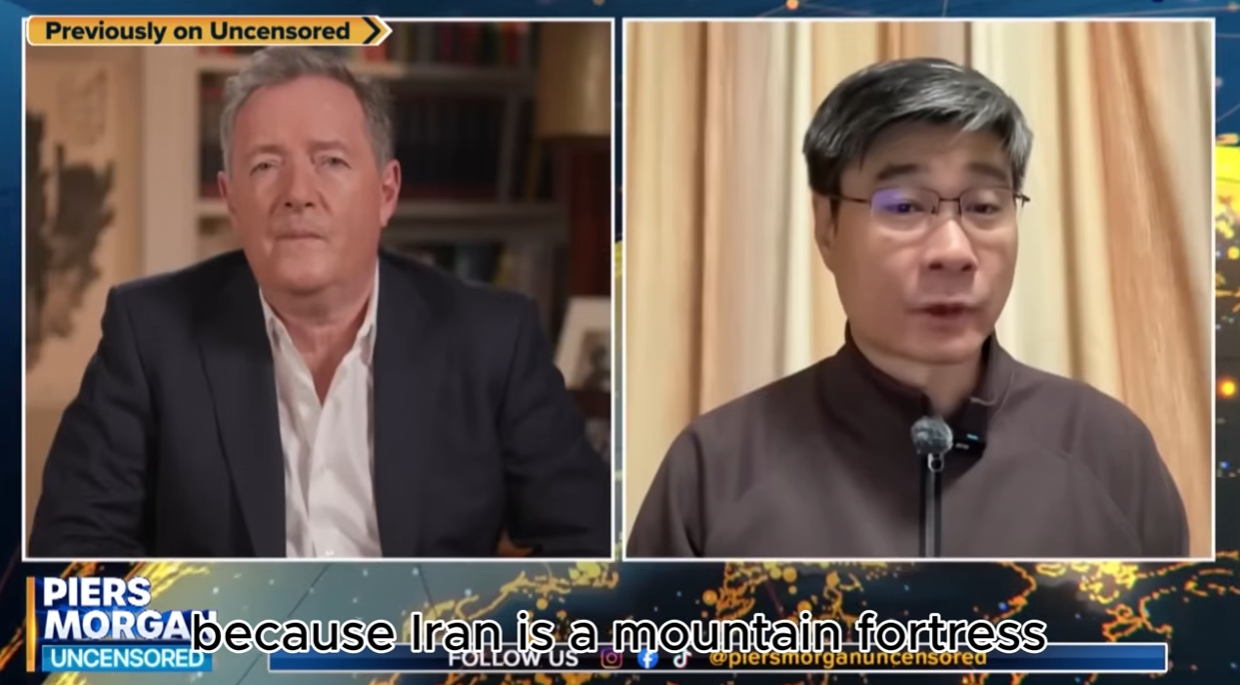
Zhang Shei Quin, a game theorist better known publicly as Professor Zhang, warned that the United States could become trapped in a prolonged ground war if President Donald Trump chooses to send American troops into Iran.
His central argument was blunt. Iran’s geography, military resilience and the political costs of a prolonged occupation could turn the conflict into a Vietnam-style quagmire.
“America should not be in this war,” Zhang said. “Now that this war has started, I think it’s imperative that Americans recognize that this war is lost and refuse to commit ground troops.”
He warned that a ground intervention could create a cycle of escalation that Washington would struggle to reverse.
“Once you send in ground troops, you’re stuck there for 10 years,” Zhang said.
The warning came during a broader discussion about China, Iran, global energy supplies and the strategic importance of the Strait of Hormuz.
China May Not Be the Clear Winner
The debate began with a question that has dominated discussions about the conflict: Is China benefiting from the war without having to fight it?
Zhang rejected the idea that Beijing can simply sit back and enjoy the consequences of a prolonged U.S. campaign.
He argued that China has too much economic exposure to the Middle East to welcome prolonged instability.
According to Zhang, China has invested heavily in Middle Eastern infrastructure, while Iran plays an important role in Beijing’s Belt and Road strategy. Damage to railways, energy infrastructure and trade routes could therefore hurt Chinese interests as well as those of the United States and its allies.
China also relies heavily on energy moving through the Strait of Hormuz, making prolonged disruption a potential threat to its economy.
“If this war continues for too long, then the Chinese economy may suffer,” Zhang said.
That creates a strategic contradiction for Beijing. China could gain diplomatic influence if Washington becomes bogged down in another Middle Eastern conflict, but it could also suffer from higher energy costs and disrupted trade.
Zhang said that tension helps explain why China has an interest in pushing the parties toward negotiations.
Strait of Hormuz Becomes a Global Pressure Point
The Strait of Hormuz sits at the center of the strategic debate.
The narrow waterway connects the Persian Gulf to the Gulf of Oman and serves as one of the world’s most important routes for energy shipments. Any prolonged disruption could affect oil prices, Asian manufacturers, global trade and inflation.
Zhang argued that the conflict has demonstrated how maritime chokepoints can become powerful economic weapons.
If Iran can use Hormuz to pressure energy-importing countries, he suggested, other major powers could theoretically look at similar pressure points elsewhere.
That could put the Strait of Malacca into the strategic conversation because of its importance to Asian trade.
But Zhang stopped short of claiming that Washington had deliberately designed the Iran war around such a strategy.
The argument is instead based on the incentives created by the conflict. Once governments begin treating critical waterways as instruments of economic pressure, the consequences can extend far beyond the original battlefield.
That makes the Iran conflict potentially much larger than a confrontation between Washington and Tehran.
China Has Its Own Limits
The discussion also turned to whether China could retaliate by restricting access to its own exports.
China remains deeply integrated into global trade, making an outright embargo against foreign markets a risky proposition for Beijing itself.
Zhang argued that China benefits from maintaining international commerce rather than destroying it.
The country also faces a military limitation. While China’s naval power has expanded rapidly, Zhang questioned whether Beijing is prepared to directly challenge U.S. naval dominance across the world’s major waterways.
That distinction matters because economic influence does not automatically translate into military control.
China can use trade, diplomacy and economic relationships to increase its influence without necessarily wanting a direct confrontation with the United States.
Could Beijing Become the Diplomatic Alternative?
The war could nevertheless create an opportunity for Chinese diplomacy.
Zhang suggested that European countries, Iran and even Russia could increasingly view Beijing as a potential mediator if Washington becomes associated with military escalation while China presents itself as a supporter of negotiations.
“The Chinese are first and foremost pragmatic, and the Chinese believe in mutual trade,” Zhang said.
He argued that China could gain diplomatic influence by positioning itself as a power capable of helping stabilize the Middle East.
That would represent a different kind of geopolitical competition.
The contest would not simply involve missiles, aircraft carriers or sanctions. It would also involve which major power other countries believe can produce stability.
If the United States becomes increasingly associated with an expanding war, Beijing could attempt to exploit the contrast.
But that outcome remains a prediction rather than an established fact.
Taiwan Adds Another Layer to the Crisis
The discussion then moved from the Middle East to Taiwan.
Zhang argued that China faces its own economic constraints that could discourage Beijing from launching a major conflict over Taiwan in the near term.
He also pointed to Japan’s strategic concerns.
A Chinese takeover of Taiwan could dramatically alter the regional balance and give Beijing greater leverage over maritime routes that Japan depends on.
For that reason, Zhang said he did not expect China to invade Taiwan within the next five to 10 years.
The broader lesson, however, was that the Iran war could influence how Beijing thinks about maritime warfare and economic pressure.
If the United States can use control of critical sea routes as leverage against Iran and its trading partners, other governments will study the precedent carefully.
The Gulf States Face Their Own Risks
The discussion also raised concerns about the future of the Gulf Cooperation Council, or GCC.
The Gulf economies depend heavily on international trade, foreign investment and expatriate workers. A prolonged regional war could therefore threaten the economic model that has allowed countries across the Gulf to build major tourism, financial and entertainment industries.
Zhang argued that the conflict has exposed vulnerabilities in the Gulf security system.
He questioned whether regional governments can continue relying on American military protection if Washington’s strategy produces instability that threatens their own economies.
That uncertainty could eventually force Gulf countries to reconsider their security relationships and economic dependencies.
Why Zhang Opposes a Ground Invasion
The most consequential part of the discussion came when the conversation returned to the possibility of American ground troops.
Zhang argued that airpower alone may not achieve regime change in Iran. If Washington continues escalating without reaching its political objectives, he believes pressure could eventually grow for a ground operation.
That, he said, would dramatically change the nature of the conflict.
“Iran is a mountain fortress,” Zhang said, arguing that the United States lacks the manpower, manufacturing capacity and political will required for a long war of attrition on Iranian territory.
He also questioned the sustainability of maintaining an expensive air campaign indefinitely.
According to Zhang, the longer the conflict continues, the more difficult it becomes to justify the financial and human costs of the operation.
The danger, in his view, is a classic escalation trap.
The United States could begin with airstrikes, expand economic pressure, tighten maritime restrictions and increase military deployments. If none of those steps produces the desired political outcome, policymakers could eventually face pressure to put troops on the ground.
That is the point at which the conflict could become much harder to control.
“This War Should Not Have Started”
Zhang went further by arguing that Washington should have pursued a negotiated settlement with Tehran rather than entering the conflict.
He criticized the broader strategy of using military pressure to force political change and argued that a diplomatic agreement would have offered a less destructive alternative.
“This war should not have started,” Zhang said.
He also argued that the United States should avoid turning an unsuccessful air campaign into a ground war simply because Washington had already invested heavily in the conflict.
“Once it commits ground troops, then this war becomes a cost,” he said, warning of “mission creep” that could turn Iran into another Vietnam.
His conclusion was direct.
“I implore the Americans: do not send in ground troops.”
The warning comes down to a basic strategic dilemma. A military campaign can begin with a clearly defined objective, but each additional escalation can make the original objective harder to achieve without taking another step.
That is the danger Zhang sees in Iran.
The question is no longer simply whether the United States can inflict enough damage from the air. It is whether Washington can achieve its political objectives without becoming locked into a war that demands ever greater military commitments.
For Zhang, that is the real turning point.
The most dangerous moment may not be when the United States enters the conflict. It may come when Washington discovers that leaving is far more difficult than entering. (*)