
WASHINGTON — The rivalry between the United States and China is no longer confined to tariffs, trade disputes or military competition. The two powers are increasingly competing over technology, energy, supply chains, artificial intelligence and the rules that will shape the global order for decades to come.
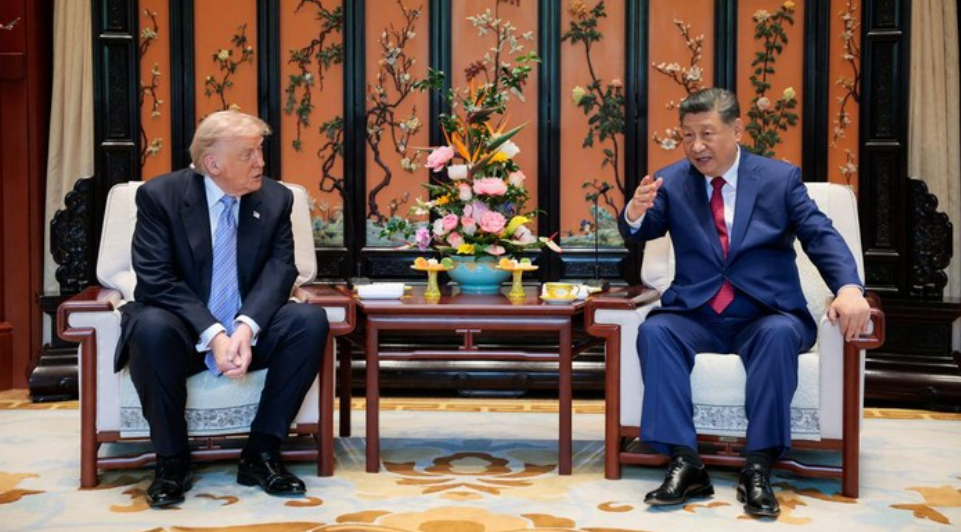
Yet beneath the public displays of cooperation between President Donald Trump and Chinese President Xi Jinping, the strategic divide remains deep.
Elizabeth Economy, a senior fellow at the Hoover Institution, said the recent meetings between Trump and Xi may help prevent tensions from spiraling, but the summits have so far produced limited substantive results.
“If I were being ungenerous, what we’ve seen over the past two summits has probably just been mostly pomp and pageantry over substantive progress,” Economy said.
She added that the repeated meetings could still serve an important purpose by creating new channels of communication between Washington and Beijing.
“I do think it’s useful to have them meet frequently,” she said.
The stakes extend far beyond the two countries. Decisions made in Washington and Beijing on trade, climate policy, national security and artificial intelligence can affect economies and governments around the world.
China Sees an Opening in Trump’s Foreign Policy
Economy argued that the Trump administration has created both opportunities and challenges for Beijing.
One major advantage for China, she said, is that the administration has moved away from framing the US-China competition primarily as a contest between democracy and authoritarianism.
The Trump administration has also reduced US involvement in a number of international institutions and agreements. Economy said that creates room for Beijing to expand its influence.
“This is all great from the Chinese perspective or reasonably great because it opens up the sort of aperture for China to step in and assume leadership roles,” Economy said.
China, however, is not interpreting the shift as a signal that Washington has abandoned competition.
The United States continues to view China as its most significant long-term strategic competitor, particularly in technology and national security.
Economy pointed to the Indo-Pacific as evidence that Washington is still strengthening its position in Asia through closer security ties with allies and partners.
“So I think on those two fronts, the Chinese very much recognize that the United States is not taking a step back and actually is trying to become more competitive with China,” she said.
China’s Economic Strength Masks Domestic Weakness
China’s growing influence also comes with a major contradiction.
The country has become a global powerhouse in advanced manufacturing, clean technology, robotics, biotechnology and artificial intelligence. In several of those industries, Economy said, China has moved ahead of the United States.
Its clean-energy expansion is particularly striking.
China remains the world’s largest consumer of coal, but it has also emerged as a global leader in deploying renewable energy and developing a broad energy base.
Economy described China as a long-term strategic planner that has diversified its energy sources and strengthened its resilience against external shocks.
“They are our fiercest competitor,” she said.
But China’s impressive industrial capabilities do not necessarily translate into prosperity for ordinary Chinese citizens.
Economy pointed to weak domestic demand, a large gig-economy workforce, high youth unemployment and falling property values as major sources of pressure.
She said roughly 40% to 45% of urban workers are now in flexible or gig employment, while youth unemployment remains around 19%.
For many households, the property downturn is especially painful because housing has traditionally represented a major store of wealth.
“So yes, the domestic economy looks bad,” Economy said.
Still, she argued that Beijing has considerable political capacity to maintain its current economic strategy despite those pressures.
China’s political system, she said, makes it much harder for economic dissatisfaction to translate into sustained public protest.
Washington Faces a Difficult Choice on China
The central question for the United States is how much economic dependence on China remains acceptable.
American policymakers increasingly want critical industries such as semiconductors, advanced technology and other strategic goods to be produced domestically or within trusted allied supply chains.
But defining which products are truly critical has become increasingly difficult.
Economy said the debate now extends beyond obvious national-security technologies.
“As we identify more and more goods, for example, Wi-Fi routers, right? That’s a new one, or EVs, right? All connected goods,” she said.
The challenge is determining where national security concerns should override the efficiency of global markets.
“The job is to figure out the difference between cosmetics and semiconductors,” Economy said.
That debate has become particularly important in the semiconductor industry, where American technology companies have significant commercial interests in China.
Economy rejected the idea that maintaining access to US semiconductor technology would necessarily keep China dependent on American companies.
She pointed to China’s “Made in China 2025” strategy, which set a goal of dramatically increasing domestic semiconductor production.
“Xi Jinping is not” willing to remain dependent on US semiconductor technology, Economy said.
In her view, Beijing’s push for technological self-sufficiency means the United States must consider both commercial interests and long-term strategic realities.
The Next Space Race May Test America’s Confidence
The rivalry is also expanding beyond Earth.
China has made space exploration a national priority, while the United States continues to rely on government programs and an increasingly powerful private-sector space industry.
Economy rejected the idea that America has already lost the space race.
She noted that the United States has built a broad international coalition through the Artemis Accords, while China and Russia have developed their own cooperation framework.
“I don’t think we’re out of the game here,” Economy said.
At the same time, she warned against defining American success simply as preventing China from achieving major technological milestones.
“I don’t think that our objective should be to keep China down,” she said.
The real concern, she argued, should be China’s ability to develop technologies that could directly threaten US national security, including capabilities that could potentially disable American satellites.
Preventing China from putting an astronaut on the moon, she said, should not be America’s objective.
AI Competition Is Far From Decided
Artificial intelligence may ultimately become the most consequential arena of US-China competition.
Trump has repeatedly emphasized the strategic importance of AI, while China has invested heavily in domestic AI models and infrastructure.
But Economy challenged the idea that public concern about AI in the United States means America is falling behind.
She pointed to concerns over AI safety, autonomous systems, data centers, energy consumption and environmental effects as legitimate issues that Americans should debate.
The United States also has a significant infrastructure advantage. Economy said America currently has roughly 10 times as many data centers as China, while domestic AI adoption is broadly comparable between the two countries.
China, meanwhile, has its own constraints, including government controls over AI-generated content and certain applications.
Economy also questioned the common assumption that Chinese citizens are inherently more optimistic about AI.
“I think there’s a form of techno-determinism in China,” she said.
According to Economy, the Chinese government has made clear that AI development is a national priority, leaving less room for citizens to openly reject or challenge the direction of policy.
That is different, she argued, from genuine public optimism.
Neither Side Knows Who Will Win
The outcome of the AI race remains uncertain.
Economy said the definition of “winning” itself matters. Technological leadership, domestic adoption, commercial success and global influence could produce different winners.
“I don’t think we know who is going to be winning,” she said.
She expressed confidence in the ability of the American system to compete but acknowledged that Washington has yet to demonstrate a clear strategy for persuading other countries to adopt US AI technology and standards.
“China’s got the whole stack ready to go. I don’t think we’re in that position yet,” Economy said.
That may ultimately define the next phase of the US-China rivalry.
The competition is no longer simply about which country has the larger economy or stronger military. It is increasingly about whose technologies, supply chains, standards and institutions other countries choose to depend on.
For Washington, the challenge is to compete without turning every Chinese success into an existential threat.
For Beijing, the challenge is equally complicated: maintaining its rise as a global industrial and technological power while confronting serious weaknesses at home.
The relationship between the world’s two largest powers is therefore likely to remain both competitive and interdependent. Neither Washington nor Beijing appears prepared to surrender its ambitions, but both have strong reasons to prevent the rivalry from becoming uncontrollable. (*)