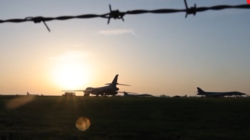

WASHINGTON — The United States has abruptly pulled all of its bombers from RAF Fairford in England and sent them back to American bases, turning a previously routine deployment into a major security signal as concerns grow over threats linked to Iran.
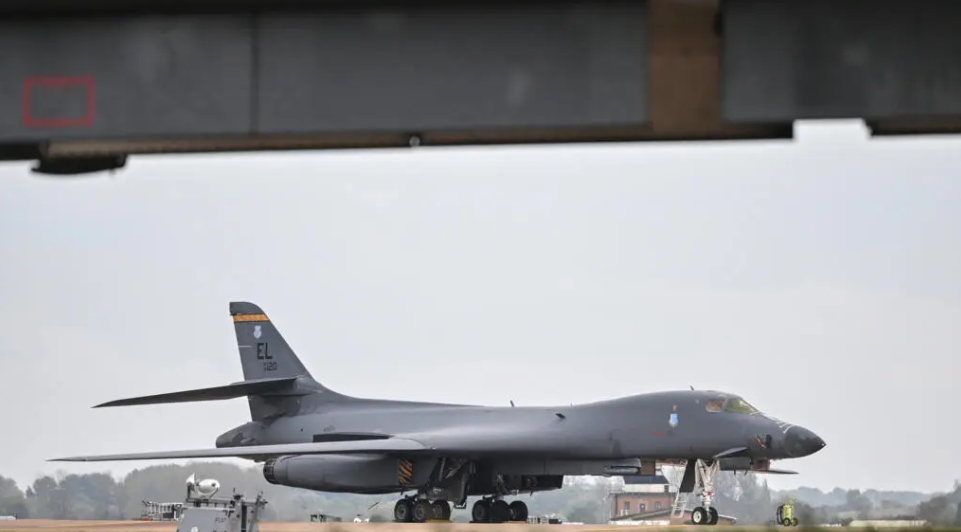
The Pentagon confirmed that every U.S. bomber deployed at the Gloucestershire air base has returned to its home station in the United States. About a dozen B-1B Lancer bombers had been operating from Fairford, a key forward base for American long-range airpower in Europe.
The timing makes the move particularly significant.
British counterterrorism authorities recently arrested six people in connection with a suspected plot near RAF Fairford. Five British men were arrested on September 27 after police responded to reports of suspicious activity involving several vehicles near the base. A sixth man, a 25-year-old dual British-Iranian national, was arrested several days later in London.
The suspects have since been released on bail while the investigation continues. British authorities have not publicly established that Iran ordered the alleged plot, although senior U.S. officials have pointed to possible involvement by a foreign actor and Iranian links have become a major focus of the investigation. Tehran has denied involvement.
For the United States, however, the response is unmistakable: the bombers are no longer sitting within easy reach of the European theater.
A Sudden Move From a Critical Forward Base
RAF Fairford is not an ordinary airfield.
The base serves as one of the most important locations available to the U.S. Air Force for deploying heavy bombers in Europe. Its long runway and strategic location allow American aircraft to operate closer to potential targets than they could from the continental United States.
That forward positioning can significantly reduce the time required to reach the Middle East.
B-1B bombers can fly long distances and carry large weapons loads, making them particularly valuable for sustained strike operations. By keeping them at Fairford, the United States maintains a powerful long-range strike option close to the European and Middle Eastern theaters.
Removing the aircraft changes that equation.
The Pentagon said, “all U.S. bombers that were deployed to RAF Fairford have re-deployed to their home stations in the United States.”
The statement did not publicly identify the specific threat that prompted the move. It also did not indicate how long the bombers would remain in the United States.
That ambiguity matters.
The United States could redeploy the aircraft if commanders determine that the threat has passed. But for now, Washington has decided that the operational benefit of keeping the bombers forward-deployed does not outweigh the security risk.
Why the Recent Arrests Matter
The Fairford withdrawal follows an unusually serious security incident.
On September 27, police responded after a local resident reported suspicious activity involving several masked men and vehicles close to the air base. Authorities launched a major security operation, and residents in the surrounding area faced evacuations while investigators examined the vehicles.
British counterterrorism investigators later arrested a sixth suspect in London.
Authorities have not publicly confirmed that the suspects had explosives capable of destroying the base or its aircraft. That distinction is important because the investigation remains active and the suspects have not been convicted of any offense.
Still, the incident raised a more dangerous possibility for U.S. commanders: an adversary may not need to launch a conventional attack to disrupt American airpower.
A successful sabotage operation against aircraft sitting on a runway could impose an immediate operational cost.
The B-1s are highly visible assets. Unlike ships operating hundreds of miles offshore or aircraft flying from distant bases, bombers parked at an airfield present a fixed target.
That vulnerability appears to have influenced the U.S. decision.
Iran Becomes the Central Question
The biggest unanswered question is who was behind the suspected plot.
British authorities continue to investigate, while U.S. officials have indicated that a foreign actor may have played a role. Iran has rejected accusations of involvement.
The suspicion does not come from the Fairford incident alone.
Iran has repeatedly threatened U.S. and allied military facilities involved in operations against Tehran. RAF Fairford also played an important role in U.S. military operations against Iran, making it an obvious location of strategic interest.
That creates a difficult problem for Washington and London.
If Iran or an Iran-linked network was responsible for the alleged operation, the incident would demonstrate that the conflict’s security risks extend well beyond the Middle East.
It would also show how vulnerable military infrastructure can become when forces are deployed close to a conflict zone.
For Washington, the calculation is straightforward: a bomber sitting at Fairford is useful because it shortens the distance to the battlefield, but it also creates a target that an adversary can potentially reach without confronting the aircraft in the air.
The Cost of Bringing the Bombers Home
The United States does not lose its long-range strike capability simply because the B-1s leave Britain.
The aircraft can still launch missions from bases inside the United States. They can also use aerial refueling to reach distant theaters.
But distance creates friction.
A bomber flying from the continental United States needs more time to reach the Middle East than one operating from a forward base in Britain. Long-distance missions also require extensive tanker support, increase aircraft wear and consume more operational resources.
That makes Fairford’s location strategically valuable.
The withdrawal therefore does not eliminate U.S. strike capability. Instead, it reduces the speed and flexibility with which Washington can deploy that capability from Europe.
The distinction could become important if the conflict with Iran escalates again.
A Warning About the Limits of Forward Deployment
The Fairford decision also highlights a broader problem facing the U.S. military.
American forces rely on a network of overseas bases to project power around the world. Those bases provide speed, logistics and access. But they also create fixed locations that adversaries can monitor and potentially target.
That trade-off becomes more difficult during a conflict.
A forward base gives the United States an advantage only if it remains secure enough to operate from.
The Fairford withdrawal suggests U.S. commanders currently see the security risk as more important than the advantage of keeping the B-1s there.
That is a significant judgment.
It also does not necessarily mean the United States has abandoned Britain as a military platform. Other American forces remain stationed in the country, and RAF Fairford itself could potentially support U.S. operations again if the security situation changes.
Iran Could Portray the Withdrawal as a Victory
Even if Washington describes the move as a precaution, Tehran could use it for political messaging.
The withdrawal allows Iran to argue that threats against American military infrastructure are forcing Washington to reconsider where it stations its most powerful aircraft.
But that interpretation has limits.
The United States still possesses a large long-range bomber force, and returning the aircraft to American bases does not remove them from the fight. It simply places additional distance between the bombers and potential targets.
The move also does not prove that Iran carried out or ordered the alleged Fairford plot.
That distinction will become increasingly important as investigators determine whether the suspects had connections to Iranian intelligence or acted independently.
What Happens Next?
The immediate question is whether the B-1s remain in the United States or eventually return to Europe.
If the aircraft return to Fairford after security measures improve, the withdrawal could ultimately prove temporary.
If they remain at home for an extended period, however, the move could signal a deeper reassessment of the risks associated with forward-deploying American bombers in Britain.
The timing also matters because U.S. military planners must balance several competing priorities: protecting personnel and aircraft, maintaining rapid strike capability, preserving alliances and preparing for the possibility of renewed combat operations against Iran.
For now, the message from Washington is cautious rather than confrontational.
The bombers have moved.
The reason remains only partly disclosed.
And the suspected plot near RAF Fairford remains under investigation.
That combination makes the withdrawal more than a routine redeployment. It is a visible indication that the security environment surrounding U.S. military assets in Europe has changed, and that Washington is willing to sacrifice some operational convenience to keep its most valuable aircraft out of a potential danger zone.
The strategic question is no longer simply whether the United States can strike from Europe.
It is whether maintaining that forward position is worth the growing risk of keeping high-value American bombers exposed on the ground. (*)